For the room
New York Café
The gilded hall
See the optionsGuides
Language
Currency
See availabilitystarting at €57 · free cancellationHands-on checklist
To-do list · 11 items
Tap to check items off; your progress is remembered on this device.
0 / 11 ready
You are all set. Only the date and your group size are left to choose.
Get a seatA typical breakfast in Budapest might be curd cheese on bread, a warm crescent pastry or a café plate with eggs and lecsó. Then come the coffeehouses, the cake counters and the question of what it all costs.
Editorial team, budapestfoodtour.click · Updated November 8, 2026 · Takes 7 min
Summary view
A typical breakfast in Budapest is savoury and simple. Bread is the base, and on it goes körözött, a spread of curd cheese seasoned with paprika and caraway, which the tourism agency calls a favourite at the Hungarian breakfast table.1 Cold cuts, peppers and a sliced tomato fill the rest of the plate. It is a breakfast built to keep you going until a late lunch, and every bakery and supermarket sells the makings.
Pastries are the sweet alternative. The Hungarikum Committee paints a picture of warm pozsonyi kifli, crescent pastries filled with walnut or poppy seed, set out with a mug of hot chocolate for breakfast.7,8 Pogácsa, a small savoury scone often made with cheese or crackling, is the other bakery staple, traditionally offered to guests as they arrive.9 Buy a few from a bakery counter in the morning and you have breakfast for a walk.
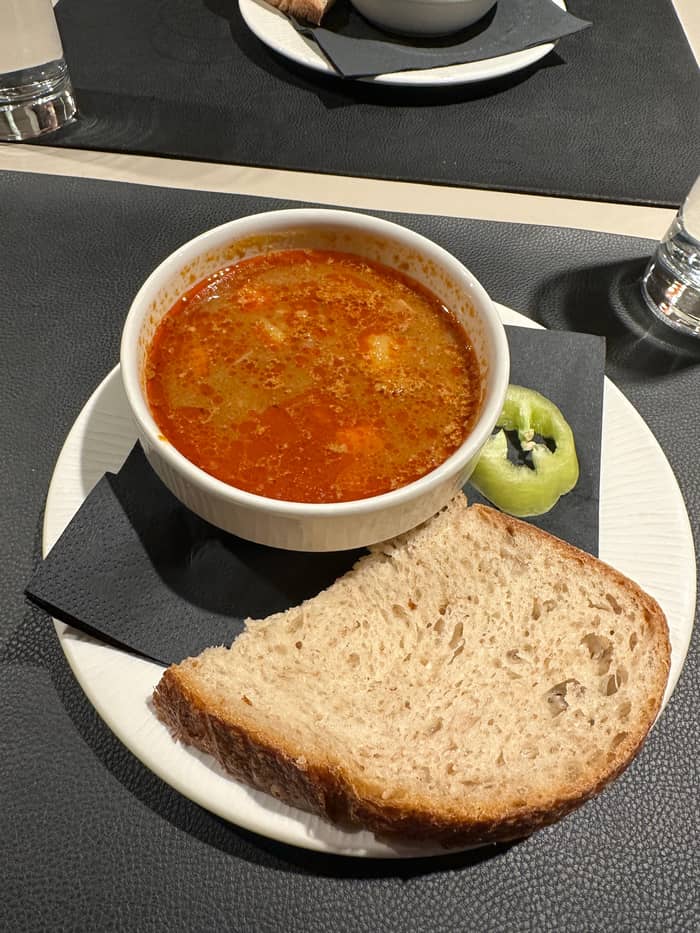
Cafés serve a heartier version. The New York Café lists a traditional Hungarian breakfast platter of lecsó, sausage and fried eggs at 6,125 Ft.10 Lecsó, the stew of peppers and tomato, belongs to late summer in home kitchens, but cafés keep it on the breakfast menu all year.11 Order it if you want a breakfast that tastes of Hungary rather than of a hotel buffet.
Coffee did not win Hungarians over at once. Under Ottoman rule they called it black soup and were not impressed.15 The first Hungarian coffee house opened in 1714, run by a merchant known as Balázs the Coffee-Maker.12 Over the following generations the habit took hold so firmly that Budapest was known as a coffee city, with about 500 cafés by the turn of the 19th and 20th centuries.16 They were clubs, offices and reading rooms as much as places to drink.
Today's taste is Italian. The tourism agency notes that Hungarians still prefer a strong espresso and milk-foam drinks such as cappuccino and latte macchiato to the longer coffees of Western Europe.2 Following the Viennese café tradition, strong coffee comes with something sweet.17 So order a presszó, the local name for an espresso, and a slice of cake, and you are doing it the Budapest way.
A newer wave of speciality cafés roasts its own beans and pours filter coffee as well. The tourism agency points to Újlipótváros as the district where these cafés are most common, along with Bartók Béla út in Buda.18 They are smaller and plainer than the grand coffeehouses, often with better coffee and fewer tourists. Mix both kinds: a historic room for the experience, a modern bar for the cup itself.
Gerbeaud on Vörösmarty tér is the grande dame. Henrik Kugler opened it in 1858, the Swiss-born Emil Gerbeaud later took it over, and from 1948 to 1984 it ran under the name Vörösmarty.13 It is now a café and confectionery in one, open 9:00-20:00 from Sunday to Thursday and 9:00-21:00 on Friday and Saturday, with no reservations taken.25,26 Its shop sells cognac sour cherries, chocolates and biscuits to take home.28
Centrál on Károlyi utca, founded in 1887, is where the literary magazine Nyugat began in 1908.21 It was shut in 1949 and only reopened as a café in 2000.14 Művész on Andrássy út began as Little-Gerbeaud and still draws the theatre crowd.29 The Hadik in Buda, founded in 1906 and famous in the 1920s for its writers, reopened in 2010.22,30 Each has its own mood, from literary to theatrical.
The oldest room on this list is a cake shop. Ruszwurm, a few steps from Matthias Church in the Castle District, was opened by the confectioner Ferenc Schwabl in 1827 and keeps its Biedermeier furniture.5 Empress Elisabeth had its cakes delivered to her.31 It is tiny and often full, so go early or late. History is everywhere in these rooms: Sándor Petőfi and his friends planned the 1848 uprising in a café, the Pilvax.32
Choose your café
Pick by the hour, the budget and what you want to see.
If I want a spectacular room
The New York Café
If I want cake above all
Gerbeaud
A café and confectionery since 1858.13
If I am up in the Castle District
Ruszwurm
Near Matthias Church since 1827.5
If I want great coffee, few tourists
A speciality café
New-wave cafés cluster in Újlipótváros.18
If I want to bake something
A chimney cake workshop
A 1-hour class in the city centre.
Three classic rooms
For the room
The gilded hall
See the options
For cake
Cakes on the square
See the options
For lunch
The literary café
See the optionsIn 1894 the New York Café opened downstairs in a palace built as the Budapest headquarters of the New York insurance company, designed by Alajos Hauszmann.3,36 Legend says the playwright Ferenc Molnár threw its keys into the Danube on opening day so it could never close.37 Writers were brought free pen, ink and paper.38 It was restored to its original splendour in 2006.3 The gilded hall is the reason most people come.
So what to eat in the New York Café in Budapest? For breakfast, served 7.00-11.00 and again from 12.00 until closing, there are New York Eggs Benedict at 6,300 Ft and the Hungarian breakfast platter at 6,125 Ft.4,20,10 From the hot kitchen, the beef goulash with csipetke is 5,775 Ft.39 The house speciality is a cappuccino topped with edible 24-carat gold at 4,900 Ft, and the Somlói galuska costs the same.19,40
Timing changes everything here. The café opens Monday to Wednesday 7.00-24.00 and Thursday to Sunday 7.00-01.00, and it says its most peaceful hours are between 7 and 9 AM and after 10 PM.27,23 Nobody needs a booking, tables go in order of arrival, and so queues form at midday.24 Come for an early breakfast and you will see the hall at its best, with light on the gold and room to look up.
Bake your own
Set your group size and compare hands-on pastry classes in the centre.
Side-by-side: 2 options
Set your group size and compare hands-on pastry classes in the centre.
≈
View≈
ViewAll amounts are from-prices on GetYourGuide, converted at the ECB reference rate. Exact prices are shown at booking.
Coffee in Budapest
If you are deciding what dessert to eat in Budapest, start with Dobos torta. It is a sponge cake with chocolate buttercream and a hard caramel lid, introduced at the National General Exhibition in 1885, and the royal couple, Franz Joseph and Elisabeth, were early tasters.33,41 Its buttercream was new at the time, and the cake travelled well, which helped it spread across Europe.33 The New York Café sells a slice for 5,250 Ft.42
Somlói galuska is the soft, boozy option. Created by a Gundel confectioner for the Brussels World's Fair in 1958, it is built from three types of sponge, plain, cocoa and walnut, soaked in rum syrup and layered with vanilla cream.43,44,34 It arrives in spoonfuls under whipped cream and chocolate sauce. Esterházy torta is the other cake the tourism agency ranks among the most iconic, and you will find it on almost every counter.45
Beyond the famous names, look for the cakes Hungary invented: zserbó, layered with walnut and apricot, and Rákóczi túrós, apricot on a curd cheese base.45 Gundel pancakes come with a walnut and rum filling under dark chocolate sauce.46 Rétes, the strudel, is the everyday sweet, filled with poppy seed, curd cheese, apple or sour cherry.35 Order one of each with friends and share; cake shops expect it.
Video
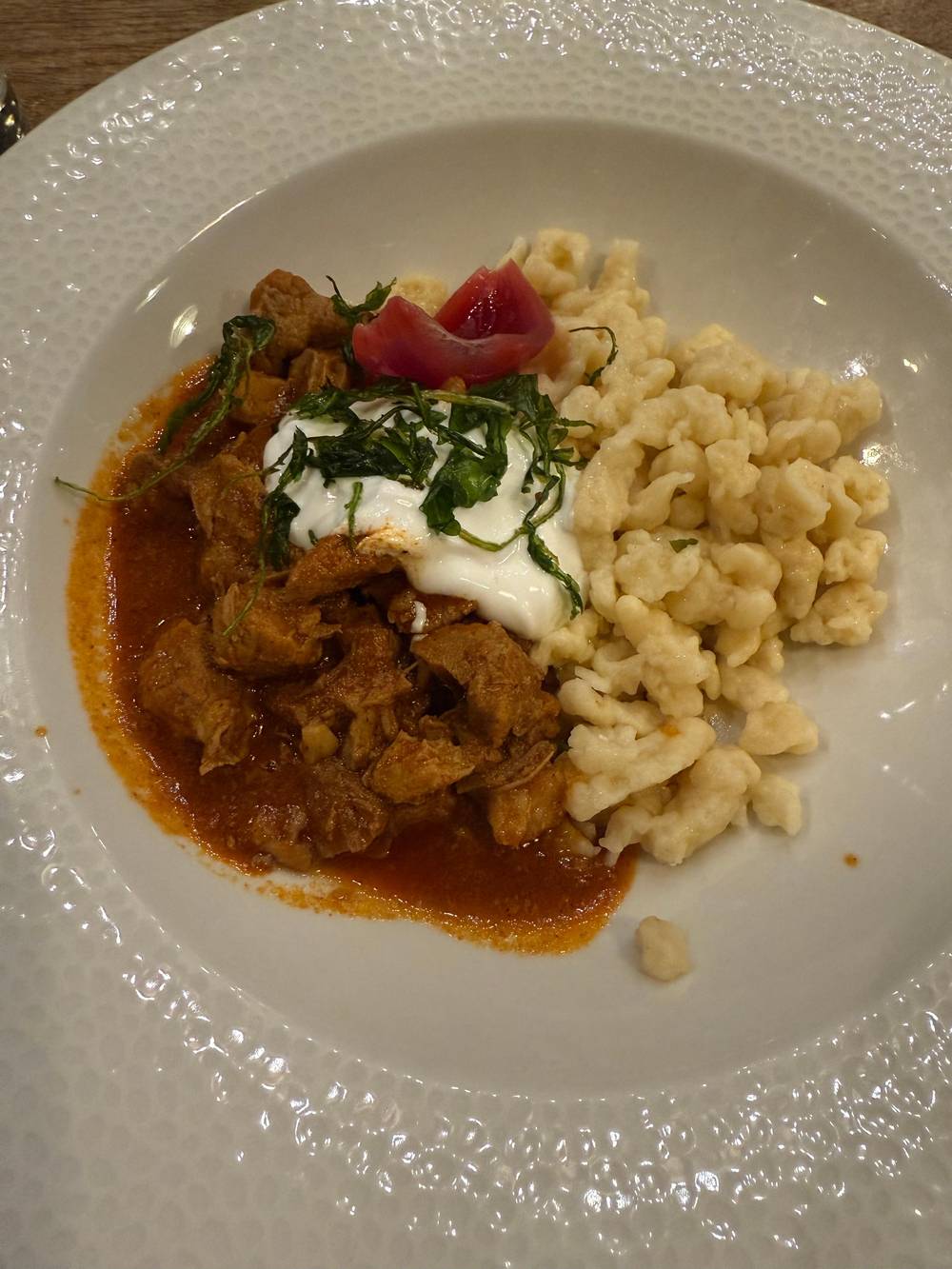
Stuffed Cabbage Adventures on YouTube · The video waits until you tap play to load.
in line with the traditions of Viennese cafés, pastries are offered to accompany the strong coffee
Bakery counters are a cheap way to eat well in the morning. Pogácsa comes in many versions, with potato, cheese, butter, curd cheese, cabbage or crackling worked into the dough.9 Pozsonyi kifli, the walnut and poppy seed crescents, have a long history: by the Hungarikum Committee's account, Pozsony bakers were selling them in the late 1500s.47 Pair either with an espresso standing at the counter.
Rétes is worth a dedicated stop. The stretched pastry is not originally Hungarian, the tourism agency admits, but Hungarians have taken it as their own, and the classic fillings are poppy seed, sweet curd, apple and sour cherry.35 Good bakeries sell it by the slice through the day. Ask for it warm if they have an oven, and buy two flavours to compare.
Chimney cake, kürtőskalács, is the pastry you can make yourself. Strips of sweet dough are coiled onto a roller, sugared and turned over the heat until the crust is glossy.48 The chimney cake workshop in the city centre runs for 1 hour, taught in English, from €31. Another chimney cake workshop runs 65 minutes from €21. It is a good rainy-morning plan, especially with children.
How much is breakfast in Budapest depends on where you sit. At the top end, the New York Café charges 2,975 Ft for an espresso, 6,125 Ft for its Hungarian breakfast platter and 6,300 Ft for eggs Benedict.6,10,20 Those are palace prices for a palace room. Treat a breakfast there as a sight with a meal attached, and budget for it as you would a museum ticket.
Bakeries and neighbourhood cafés cost far less. A pastry and an espresso at a counter is the everyday Budapest breakfast, and a market hall breakfast of lángos or a sausage is cheaper still. On weekdays the Great Market Hall unlocks its doors at 06.00, ahead of the cafés, which suits early risers.49 Speciality cafés sit in between, with good coffee and simple food at modest prices.
Plan the grand cafés around their quiet hours. The New York Café is calmest between 7 and 9 AM, so an early breakfast there avoids the midday queue.23 Gerbeaud opens at 9:00 and takes no reservations, which makes a mid-morning coffee on its terrace easy.25,26 Keep cake for the afternoon, when the counters are full and the rooms are at their most sociable.
FAQ
No booking is needed: tables are given out in order of arrival.24
The café says its quietest hours are between 7 and 9 AM and after 10 PM.23
Gerbeaud has no reservation system; guests take free tables in order of arrival.26
The caramel-topped Dobos cake was introduced in Budapest in 1885 and is a Hungarikum.41
Ruszwurm near Matthias Church was opened by Ferenc Schwabl in 1827.5
Sources
Hungry for Budapest? Ask a real person here.