Most reviewed
Market to Tavern
Hall, bakery, restaurant
- Length3 hours
- In the hall30 minutes
- EndsFerenciek tere
Guides
Language
Currency
See availabilitystarting at €57 · free cancellationMap your stop
Budapest: Food Tour Market to Tavern: 12+ Tasters & Wines
★ 4.9 · 577 guest ratings
Browse 22 stops
Select a route, then press a pin or stop to read its note and open Google Maps.
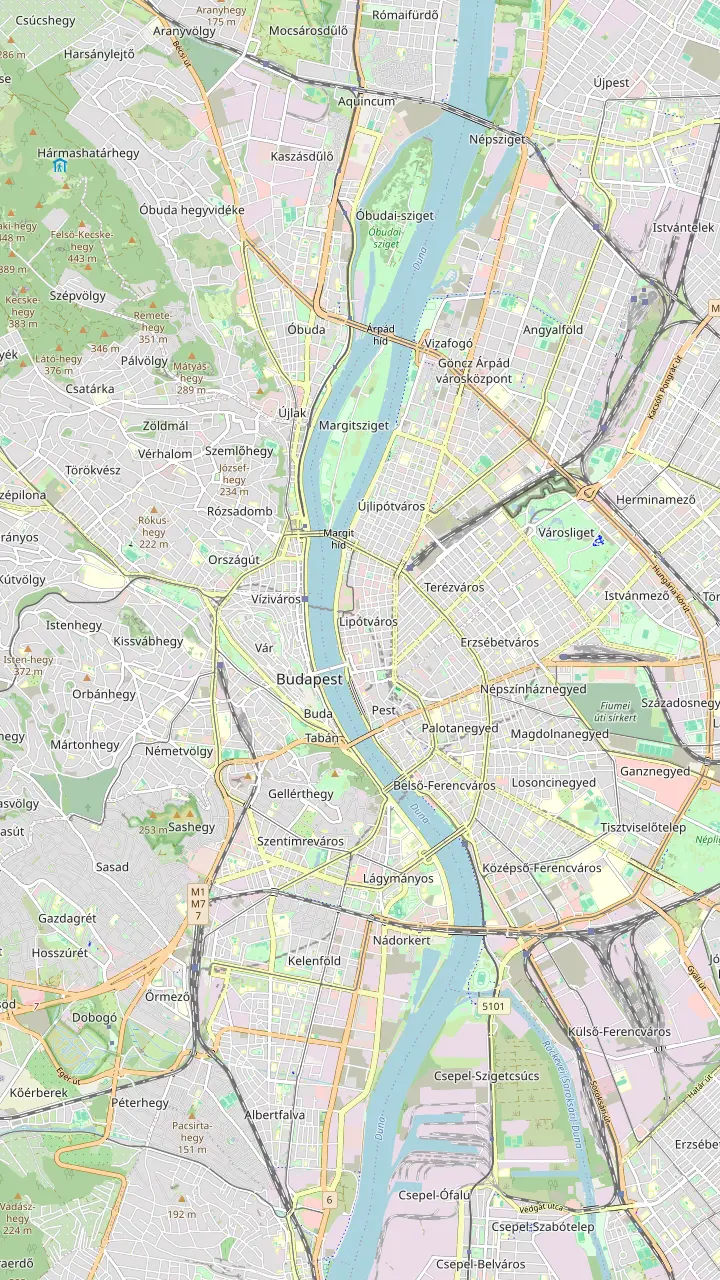
The biggest indoor market in Budapest: produce on the ground floor, counters on the gallery; open Mon-Fri 06.00-18.00, Sat 06.00-16.00, Sun 10.00-16.00.
Google MapsMetro M4 and trams 47, 47B, 48, 49 and 2 stop in front of the hall.
Google MapsA neighbourhood hall: Mon 06.00-16.00, Tue-Fri 06.00-18.00, Sat 06.00-13.00, closed Sunday.
Google MapsA Buda-side hall by the M2 and H5 stops; each stall sets its own hours.
Google MapsOne of the market halls the tourism agency names for lángos.
Google MapsA Buda market known for seasonal produce such as forest mushrooms.
Google Maps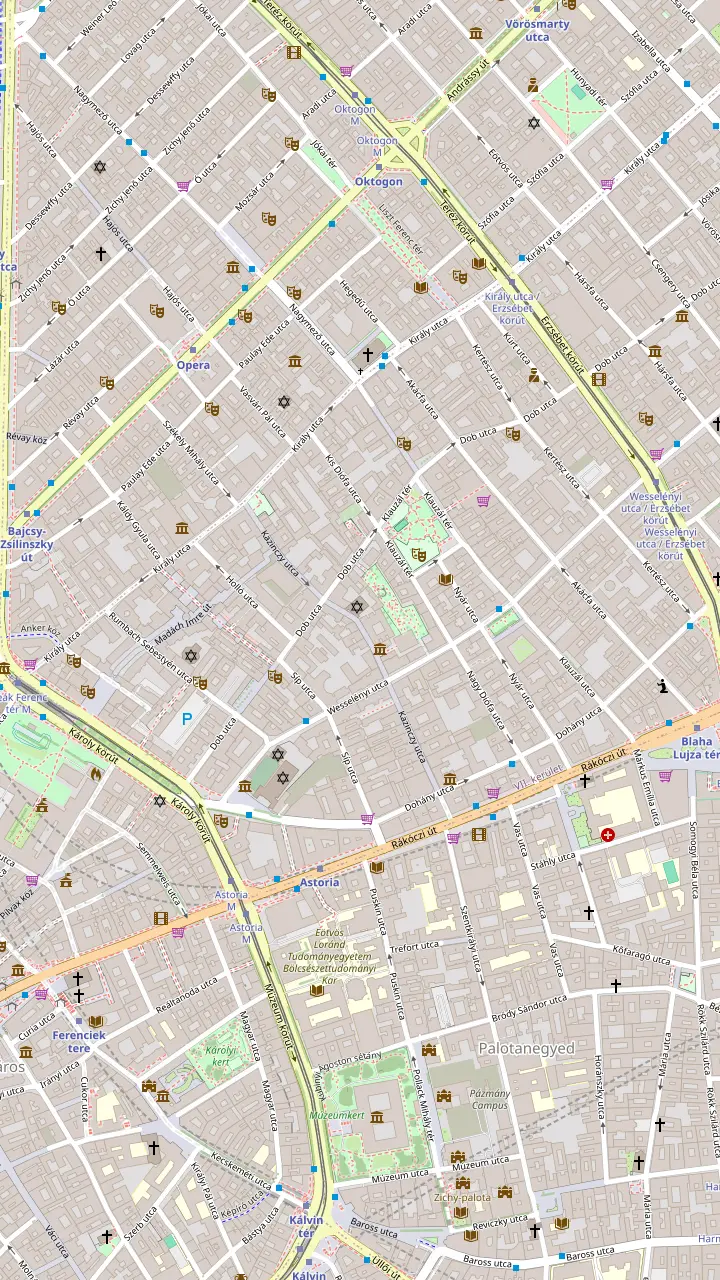
The most famous ruin bar, lively from the afternoon; a producers' market on Sunday mornings.
Google MapsA street-food courtyard at 18 Kazinczy utca with several stalls.
Google MapsBars and restaurants at the heart of the nightlife district, busy until dawn.
Google MapsA historic market hall with lángos on the gallery level.
Google MapsThe great synagogue on Dohány utca, a landmark of the Seventh District.
Google MapsKosher groceries at Dohány utca 26, open every day except Saturday.
Google MapsHungarian and Jewish one-pot dishes; book ahead.
Google MapsAn étkezde canteen serving stews, paprikash chicken and cholent.
Google Maps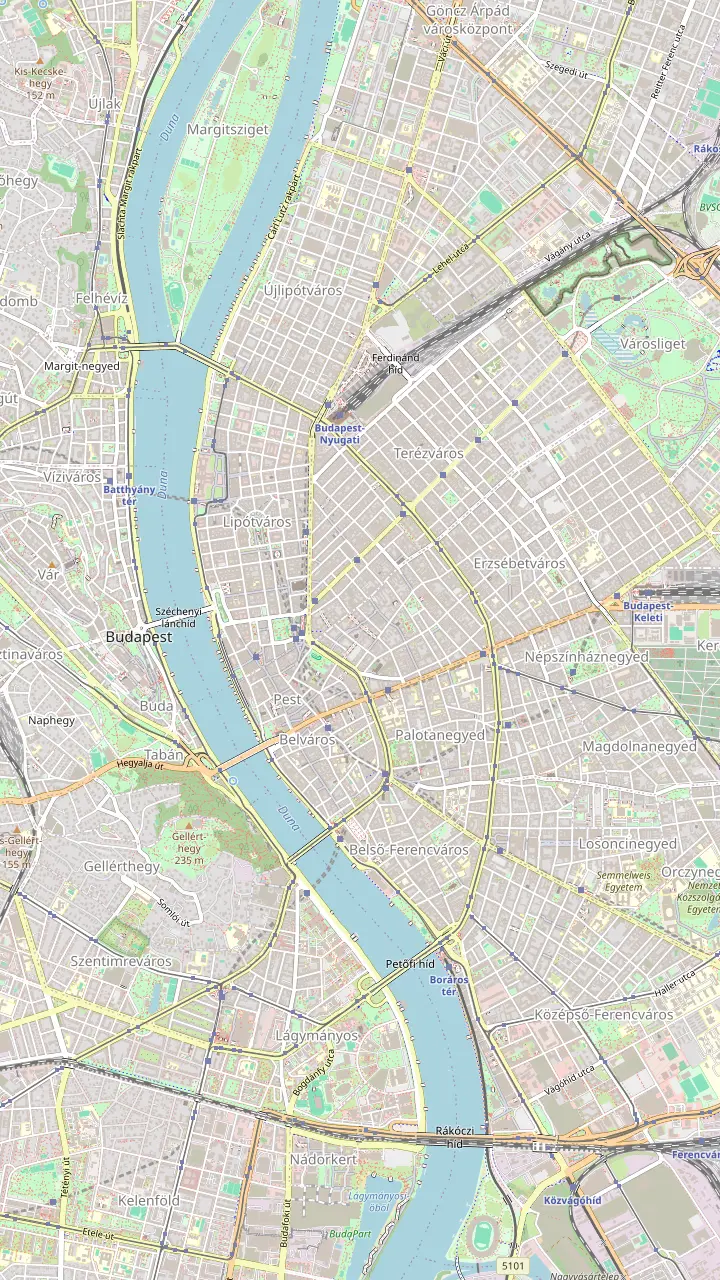
The café and confectionery on Vörösmarty tér, opened in 1858; no reservations.
Google MapsThe café where Nyugat magazine was founded in 1908.
Google MapsThe gilded café on the Grand Boulevard; quietest between 7 and 9 AM and after 10 PM.
Google MapsBegun as Little-Gerbeaud, still a favourite of the theatre world.
Google MapsA food hall in the Corvin Palace with eleven restaurants and seats for up to 800.
Google MapsA bistro near the Parliament with a classic Hungarian menu.
Google MapsA neighbourhood restaurant in Újlipótváros where locals and regulars eat.
Google MapsA literary café on Bartók Béla út, reopened in 2010.
Google Maps© OpenStreetMap contributors, map data
For the best food at the Great Market Hall in Budapest, eat upstairs and shop downstairs. Here are the hours, the floors, the counters worth queueing at and the story of the building with the tiled roof.
Editorial team, budapestfoodtour.click · Updated November 8, 2026 · Takes 8 min
Summary view
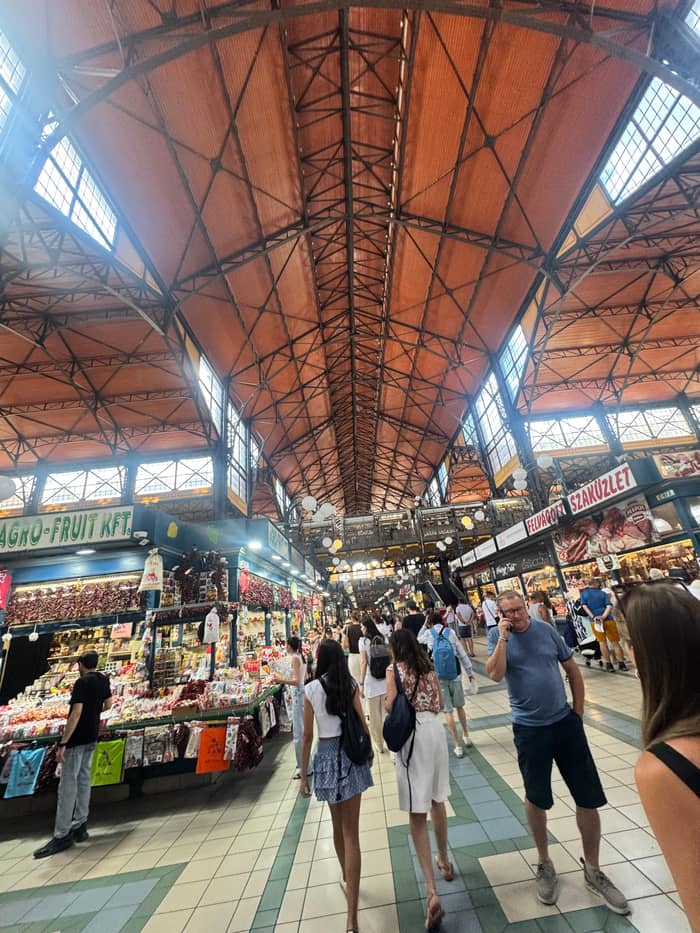
The Great Market Hall, Nagycsarnok to locals, is the biggest indoor market in Budapest, and it stands where Vámház körút meets the Liberty Bridge.7,8 It has kept its first job: the tourism agency notes that it still gives people who live nearby the widest choice of fresh farm produce in the area.9 That mix of shoppers and sightseers is what makes it fun. You queue for paprika behind someone buying a week of vegetables.
Its popularity is no secret. The operator says the hall now ranks fourth among the city's tourist attractions, and that CNN Travel named it the most beautiful market in Europe in 2013.10 It counts on average 40,000 to 50,000 visitors a day.11 Those numbers explain the crowds on the main aisle at midday, and they are the reason to arrive early if you want to look at the stalls and the produce rather than at other people's backs.
Come for three things: a market breakfast or lunch on the gallery, a slow walk past the produce, and a few edible souvenirs from the stalls downstairs. Allow at least an hour, longer if you plan to eat. The rest of this guide takes the hall floor by floor, then covers what to order, what to buy, how it came to be built and the tours that start inside it.
Find your way
| Floor | What you find | Go for |
|---|---|---|
| Basement | Fish, game, pickles, supermarket | Hungarikum street |
| Ground floor | Produce, meat, bakery | Paprika and salami |
| Gallery | Souvenirs and counters | Lángos and stuffed cabbage |
| Outside | Benches on the square | A market picnic |
Floor contents as the Hungarian Tourism Agency and the hall's operator describe them.18,15,5,4,19
The hall's operator, Budapest Market Halls, gives the opening hours as Monday to Friday 06.00-18.00, Saturday 06.00-16.00 and Sunday 10.00-16.00.1 It is closed on public holidays, and entry is free.2,3 An older tourism agency listing still shows the hall shut on Sundays, so trust the operator's page and check it before a Sunday visit.16 On a Sunday many stalls may still stay closed, so weekday mornings give the fullest picture.
Getting there is easy. Metro line M4 stops at Fővám tér in front of the main gate, and trams 47, 47B, 48, 49 and 2, trolleybus 83 and buses 15 and 115 also serve the hall.6 Tram 2 runs along the Danube embankment, which turns the trip into a short sightseeing ride. Driving is not worth it: the operator points drivers to parking in the surrounding streets such as Sóház utca, Pipa utca and Csarnok tér.17
The best time to go depends on what you want. For produce and the calmest aisles, come soon after opening. For food, aim for late morning, when the gallery counters are busy and the lángos oil is hot. Saturday mornings are lively because locals shop for the weekend, and the hall closes earlier that day, at 16.00.1 Avoid national holidays altogether, when the doors stay shut.
Time inside
Time spent inside the Central Market Hall as each listing gives it, before the rest of the tour.
The basement is the working floor. The tourism agency lists shops for game and fish, a steak shop, household appliance sellers and a supermarket down here.18 In 2015 the operator also built Hungarikum street on this level, beside the fish, game and pickle shops, to show off quality Hungarian products.15 It is a 140-metre corridor with display cases that explain each product in Hungarian and English.21
The ground floor is the classic market scene. Fruit, vegetables, meat and bread fill the stalls, and the shelves carry salami, paprika, strings of garlic, pálinka, wine and jars of honey.5 This is where locals do their shopping, so the produce is priced and displayed for them. Walk the side aisles as well as the main one: the smaller stalls along the walls are often where the pickles, cheeses and seasonal fruit look best.
The first floor is a gallery that runs around the hall and looks down on the bustle, with shops selling mostly to visitors: souvenirs and gifts.22 It is also the answer to what to eat in the Central Market Hall in Budapest: small restaurants and counters serve Hungarian dishes up here, and the gallery rail is the best viewpoint in the building for a photograph of the roof and the crowd below. Climb the stairs at either end and walk the full loop before choosing where to eat.
Plan your visit
Your time and your appetite decide the best way round.
If I only have an hour
Gallery lunch, then the ground floor
If I want quiet aisles
Come soon after opening
The doors open at 06.00 on weekdays and Saturdays.1
If It is Sunday
Go between 10.00 and 16.00
Those are the operator's Sunday hours.1
If I want it explained
Take the Market to Tavern tour
It tastes inside the hall for 30 minutes before moving on.
If I collect curiosities
Find Hungarikum street
Touch the Gömböc in the basement corridor.20
Ways to see it
Most reviewed
Hall, bakery, restaurant
Longer in the hall
Hall and street food
In German
Short tasting visit
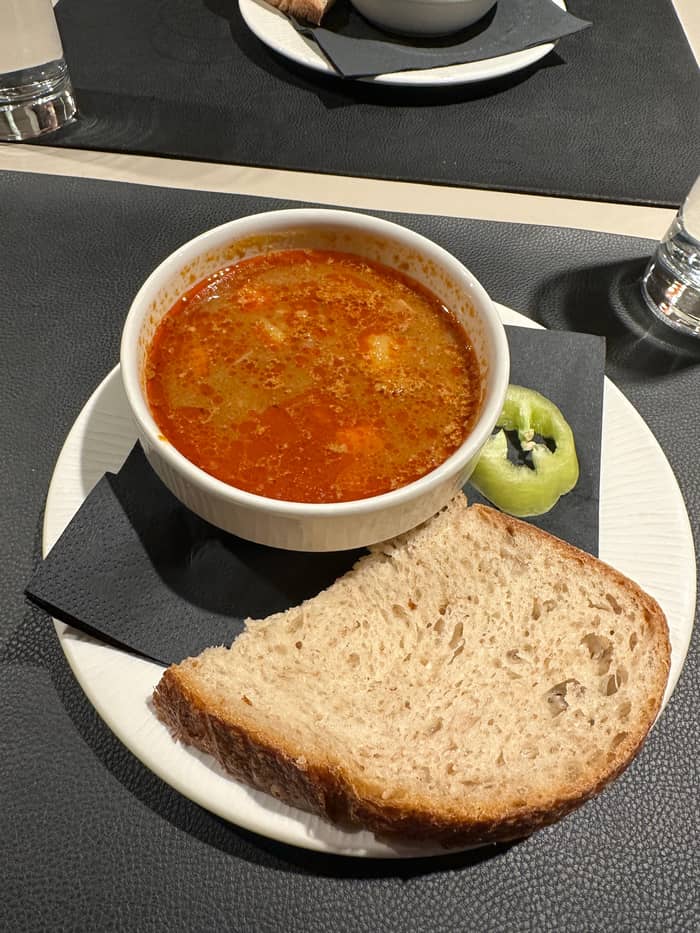
Start on the gallery, where the tourism agency recommends lángos, meat-filled Hortobágy pancakes and stuffed cabbage.4 The buffets serve fried sausages and hurka, a rice and liver sausage, alongside lángos.49 Order at the counter, point if you have to, and eat at the narrow shelves along the rail with the shoppers.
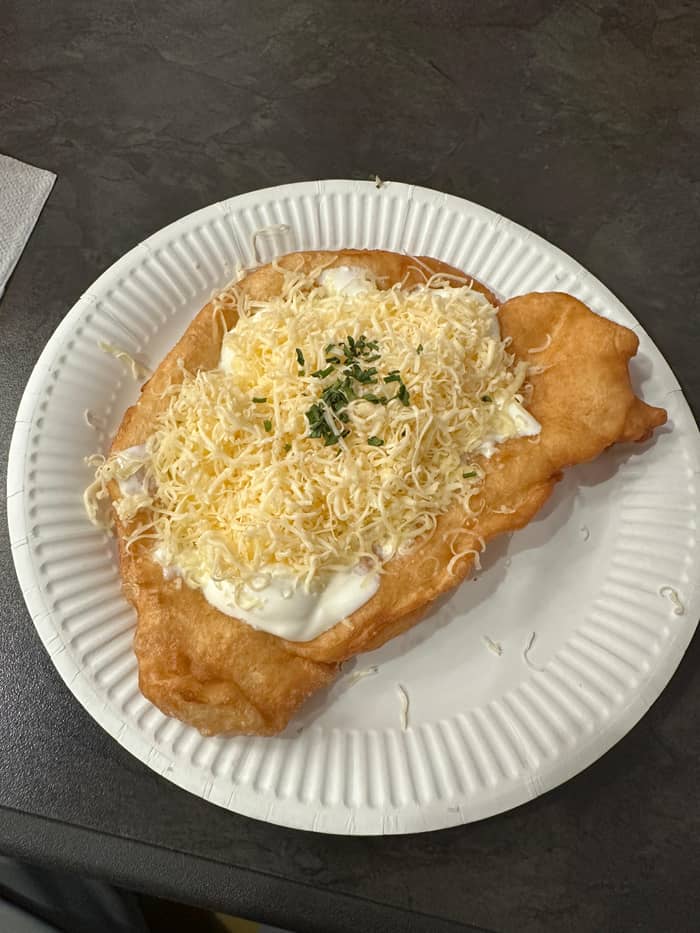
Lángos is the dish to judge the hall by. It is a yeast dough stretched flat and deep fried, then traditionally finished with garlic, sour cream and cheese.50 A good one is crisp in the middle, thick at the edges and soft inside, says the tourism agency.51 If you are hunting for the best place to eat lángos in Budapest, compare this one with the versions at the Fény utca and Lehel market halls, which the agency also recommends.26
For something to take away, buy bread, a stick of salami and a jar of pickles downstairs and eat them outside. The tourism agency suggests the benches in the square across from the hall for exactly that.19 Market eating is about speed and freshness: dishes are fried or ladled to order, eaten hot and paid for in a minute. Bring small notes and coins, since queues move faster when nobody waits for change.
Price a market tour
Set your group size and compare tours that start inside the hall.
Side-by-side: 3 options
Set your group size and compare tours that start inside the hall.
≈
View≈
View≈
ViewAll amounts are from-prices on GetYourGuide, converted at the ECB reference rate. Exact prices are shown at booking.
The hall's story
Paprika is the classic purchase. Hungarikum street presents peppers from Kalocsa and Szeged, the great paprika towns of the south.48 Ground paprika from the Kalocsa region is a protected product with a deep red colour, and the first paprika mill there was built in 1861.52,53 Buy both the mild and the hot kinds, since Hungarian kitchens use both every day.54 Choose sealed tins or bags over loose powder for the trip home.
Cured meats come next. The same corridor shows Herz and Pick salami, the sausages of Gyula and Csaba, and goose liver.48 Pick salami is cold smoked and dry matured, with a white noble mould on the casing.55,56 The shelves upstairs and on the ground floor sell them whole or sliced. Most sellers will cut you a sliver to try before you commit to a whole stick, and it is worth checking your home country's meat rules before packing one.
Sweet and liquid gifts fill the rest of the basket. The hall sells spices, pickled vegetables and honey that travel well as presents.57 Acacia honey and Tokaji aszú both appear among the products in Hungarikum street.48 Acacia honey stays runny for years without crystallising, which makes it an easy jar to carry.58 For the full shopping list and what customs allow, see our page on food souvenirs.
Video
Stuffed Cabbage Adventures on YouTube · The video waits until you tap play to load.
the market provides residents of the area with the widest selection of fresh farm produce
Ready for the market
The hall was the answer to a crisis. When Károly Kamermayer became the first mayor of Budapest in 1873, the old markets could not feed a fast-growing city.12 The press attacked the outdated, dirty street markets of the time, and a modern covered hall became urgent.59 The riverside site was chosen because goods could arrive by ship or by a rail line that ran straight to the building.60
The building was completed in 1897 to designs by the Hungarian architect Samu Pecz.13 Its facade pairs patterned brick with neo-Gothic stone gates, and its most famous feature is the roof of colourful Zsolnay tiles.61 Vilmos Zsolnay's factory supplied the ceramics, and Zsolnay pyrogranite trims the facade as well.62 Stand on the far side of the square to see the roof pattern properly before you go in.
The hall was declared a monument in 1976.14 Inside, it also holds an exhibit you can touch: the Gömböc, an object invented by Gábor Domokos and Péter Várkonyi, sits in Hungarikum street in what the operator calls the world's first Gömböc-stroking area.20 At the end of the same corridor, a three-dimensional map introduces Hungary's 22 wine regions.63 It is worth the detour downstairs even if you buy nothing.
A guided Great Market Hall food tour in Budapest explains what you are looking at and lets you taste without guessing. The Market to Tavern tour starts with 30 minutes of tasting inside the hall, then moves to a bakery, more tastings, a restaurant and a wine tasting, ending at Ferenciek tere after 3 hours. It is listed from €69. Another tour spends 45 minutes in the market before restaurants and bakeries, and lasts 3 hours from €73.
Groups have more options. The operator runs its own 6-station tasting tour, recommended for groups of 10-25 people.64 German speakers can book a short tour with tastings that spends about 45 minutes inside the hall. From spring to late autumn the hall also hosts its National Days, when a visiting country fills the main corridor with food, crafts and music for three days.65 Check the hall's events page if your dates fall in that season.
Other halls are quieter and more local. Rákóczi tér market hall opens Monday 06.00-16.00, Tuesday to Friday 06.00-18.00 and Saturday 06.00-13.00, and is closed on Sunday.23 On the Buda side, Batthyány tér market hall sets opening hours stall by stall.24 On Sunday mornings Szimpla, the famous ruin bar, turns into a small producers' market and charity kitchen between 9 a.m. and 2 p.m.66,29
FAQ
The operator states that entry to the hall is free.3
Metro M4 and trams 47, 47B, 48, 49 and 2 serve the hall.6
The operator states that the hall is closed during public holidays.2
Sources
Hungry for Budapest? Ask a real person here.