Jewish Quarter
Jewish Quarter walk
This site's tour
- Length2.5 hours
- Drinks3 or alcohol-free
- DietsVegetarian options
Guides
Language
Currency
See availabilitystarting at €57 · free cancellationHands-on checklist
To-do list · 13 items
Tap to check items off; your progress is remembered on this device.
0 / 13 ready
You are all set. Only the date and your group size are left to choose.
Get a seatWondering what to eat in Budapest? Start with soup, move on to a paprika stew, grab lángos at a market counter and finish with a layered cake. Here is every dish worth ordering and how it should taste.
Editorial team, budapestfoodtour.click · Updated November 8, 2026 · Takes 9 min
Summary view
Any honest answer to the question of what to eat in Budapest begins with a spoon. Hungarians describe themselves as a nation of soup eaters, and a meal without a bowl of soup hardly counts as a meal at home.11 The list of everyday soups runs from goulash with beef cubes and vegetables to fish soup made with carp, catfish or pike-perch, chicken and bean soups, and a cold fruit soup that turns up in summer.12 Order one as a starter and you will understand the rhythm of a Hungarian lunch.
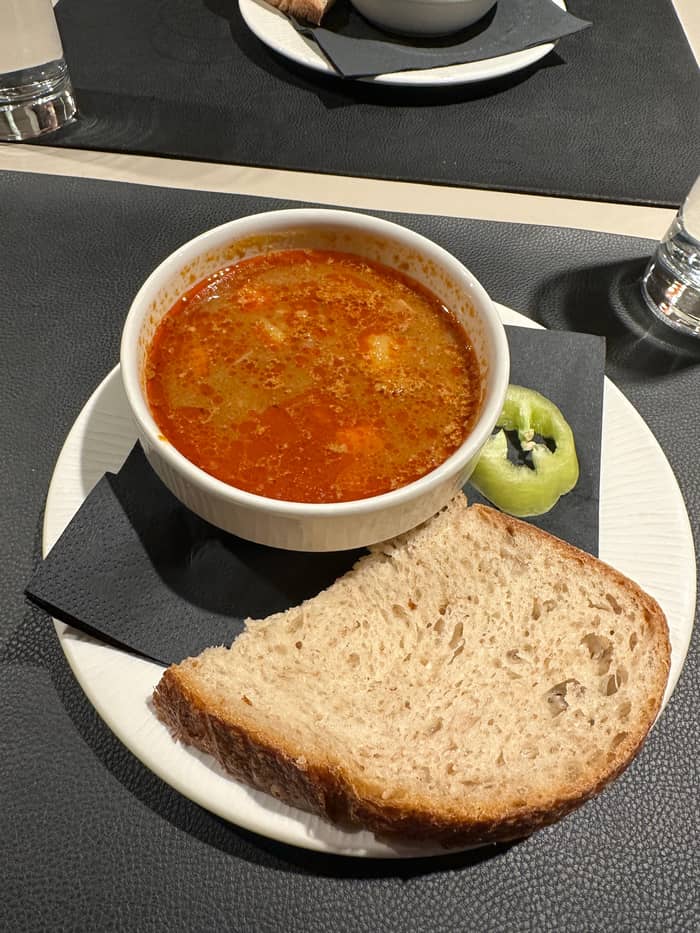
You probably know goulash by name already, but it is not the thick stew sold under that name abroad. Károly Gundel, the great restaurateur, defined it as a soup rich in broth, onions and paprika, with cubed potatoes and small pinched noodles called csipetke.1 The Hungarikum Committee adds that a good goulash is never thickened and depends on quality paprika.2 If a bowl arrives dense and floury, you have been served something else. Look for a clear red broth, soft potato and a slick of paprika oil on top.
Fish soup is the other great pot, and it divides the country into two camps. The tourism agency names the schools after the towns of Baja and Szeged: Baja soup is cooked from carp in a simpler way, while the Szeged version mixes several fish and is passed through a sieve.13 At Christmas many families still eat it, with pasta in the Baja style and without in Szeged.9 It is spicy, rust-red and filling, so treat it as a main course rather than a starter if you are planning dessert.
Know what you are ordering
| Dish | What it is | Best time |
|---|---|---|
| Gulyás | Paprika beef soup | All year |
| Csirkepaprikás | Chicken paprika stew | All year |
| Halászlé | Fish soup | Christmas |
| Töltött káposzta | Stuffed cabbage | Winter |
| Lecsó | Pepper and tomato stew | Late summer |
| Lángos | Fried dough | Market days |
| Kürtőskalács | Chimney cake | Advent |
| Somlói galuska | Rum sponge dessert | Any day |
Dishes and seasons as the Hungarian Tourism Agency and the Hungarikum Committee describe them.12,3,9,28,29,30,31
The signature main course is csirkepaprikás, chicken stewed with paprika, and it tells you more about Hungarian cooking than any single dish.3 It is almost always served with nokedli, a small dumpling pasta made from flour, eggs and salt, which soaks up the sauce.4 A swirl of sour cream finishes the plate, because, as the tourism agency puts it, Hungarians top almost everything with it.19 When you see paprikash on a menu, expect a pale orange, creamy sauce rather than a dark stew.
Pörkölt is the darker cousin and the archetypal Hungarian stew. The method starts with chopped onions fried in lard, then cubed meat and a shower of paprika, and the arguments about doing it properly never end.20 Beef, mutton, pork and chicken are all used, and the stew is also made with offal such as tripe or with game.20 In restaurants it comes with a hot side dish, while at home it is eaten with bread and pickles, which is worth copying if you want the most traditional version.
All of this rests on paprika. The Hungarikum Committee notes that the Turks brought paprika to the Carpathian Basin in the 16th-17th centuries.14 Until the 1940s Hungarian paprika was hot, and the sweet and semi-sweet kinds were made by cutting out the fiery parts by hand.21 Today both mild and hot ground paprika are used every day in Hungarian kitchens.22 Taste a stew and ask which one went in: the answer usually explains why the colour is so deep and the heat so gentle.
Some of the best things to eat in Budapest are the dishes Hungarians cook at home. Stuffed cabbage, rolls of cabbage leaf filled with minced pork, belongs to the colder months, and lecsó, a pepper and tomato stew often compared to ratatouille, peaks in late summer.28 Rakott krumpli layers potatoes with eggs and sausage, and túrós csusza, pasta with curd cheese and bacon, is the country's favourite noodle dish.34 These are filling plates, built for cold days and long lunches.
Túró, the curd cheese in that pasta, deserves its own mention. It is a fresh, white and crumbly cheese with a sour flavour, and it turns up in savoury dishes and desserts alike.35 Spread with paprika and caraway it becomes körözött, a favourite at the Hungarian breakfast table.36 If a menu lists something with túró and you have never tried it, order it: the taste is closer to a tangy ricotta than to cottage cheese, and it is one of the flavours that make Hungarian food distinct.
Főzelék is easy to overlook. It is a thick vegetable main course, cooked from peas, spinach, green beans, potatoes, lentils or Savoy cabbage, and it works for vegetarians and, with the right thickening, for vegans too.33 Canteens serve it with a fried egg or a slice of meat on top. Casserole dishes such as layered cabbage also appear on top restaurant menus now, a sign that home cooking has moved into fine dining.20,33
Order with confidence
Match your appetite and the hour, and the right plate follows.
If I want the one dish everyone talks about
Goulash soup
A clear paprika broth with beef, potatoes and csipetke, never thickened.1,2
If I want something hearty and creamy
Chicken paprikash
Chicken in paprika sauce, served with nokedli and sour cream.3,4
If I am snacking between sights
Lángos
A flatbread fried in about a minute and topped while hot.29,32
If I do not eat meat
Főzelék
A vegetable stew that suits vegetarians.33
If I want dessert with history
Dobos cake
The caramel-topped layer cake first shown in 1885.17
Taste with a guide
Jewish Quarter
This site's tour
Market start
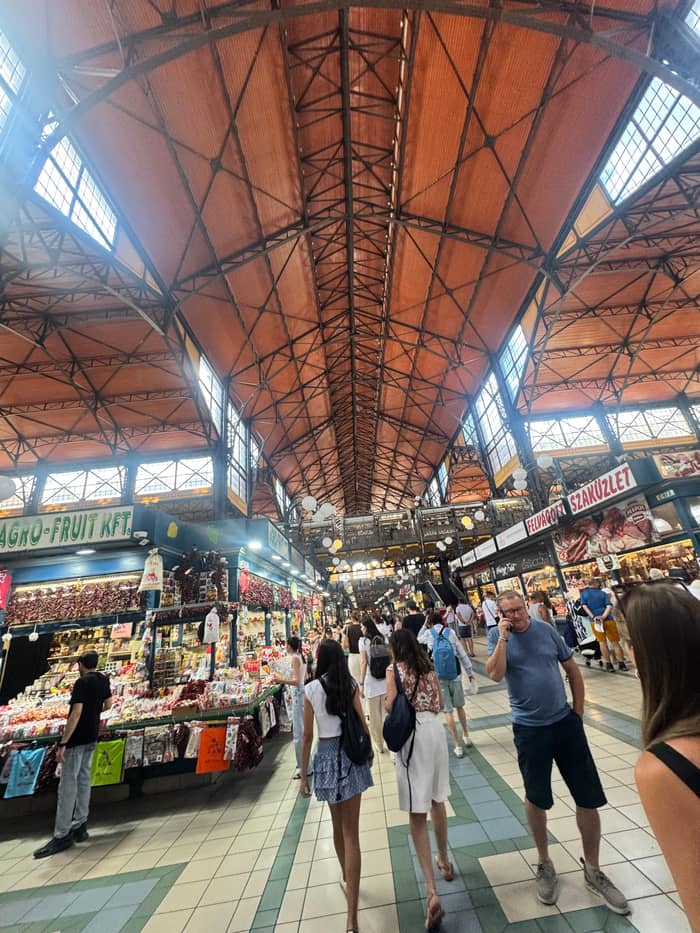
Starts in the market hall
Bites and drinks
Jewish Quarter bites
For a snack on the move, lángos is the first thing to try. It is a soft yeast dough, pulled into flat rounds and deep fried, then traditionally topped with garlic, sour cream and cheese.29 The Hungarikum Committee explains that it began as a way to use scraps of bread dough, and that the perfect one is medium thick, soft inside and crisp outside.43 It fries in a minute in very hot oil, so order it fresh and eat it standing at the counter.32
The sweet counterpart is kürtőskalács, the chimney cake: a ribbon of dough coiled on a spit, coated in sugar that turns to crisp caramel in the heat, then dusted with cinnamon or walnut.38 A predecessor was known in Hungary as early as the 16th century, but the cake as it is made today was developed in Szeklerland in Transylvania.44 One of the first written recipes appears in a book by Countess Mária Mikes of Zabola from 1784.15 Pull it apart in a spiral while it is still warm.
Meat on the street means the butcher's counter, where sausages, blood sausage and liver sausage are fried and served with sour pickles.37 At the market halls the classic bite is a pair of fried sausages with fresh bread, or lángos with cheese and sour cream.45 Fried hake is the Hungarian version of fish and chips, which is odd for a landlocked country.46 And soup in a cup has come back, from tomato soup with alphabet pasta, a childhood favourite, to heartier pots sold to go.47
Price a tasting walk
Pick how many of you are going and see the totals for each walk side by side.
Side-by-side: 3 options
Pick how many of you are going and see the totals for each walk side by side.
≈
View≈
View≈
ViewAll amounts are from-prices on GetYourGuide, converted at the ECB reference rate. Exact prices are shown at booking.
How the plate took shape
16th-17th c.
The Turks brought paprika to the Carpathian Basin.14
1784
One of the first written recipes, by Countess Mária Mikes.15
1861
The first paprika mill opened in Kalocsa.16
1885
First shown at the National General Exhibition in Budapest.17
1897
The city's biggest market hall was completed.18
1958
Created for the Brussels World's Fair.7
Hungary's cake list is long, and the tourism agency names Dobos and Esterházy as the most iconic.6 Dobos is a sponge layered with chocolate buttercream and capped with a hard caramel top.40 It was first shown at the National General Exhibition of Budapest in 1885, and its creator, the Budapest chef and delicatessen owner József Dobos, handed his recipe to the confectioners' guild in 1906.17,48 Ask for a slice with an espresso and crack the caramel with the edge of your fork.
Somlói galuska is the dessert children ask for. It was first made for the 1958 Brussels World's Fair by Béla József Szőcs, once the confectioner of the Gundel restaurant.7,49 Its first recipe stacks plain, cocoa and walnut sponge, three types in all, each soaked in rum syrup and spread with vanilla cream, raisins and walnuts, before it is torn into spoonfuls under whipped cream and chocolate sauce.31 It is messy by design, and that is how you know it is right.
Other sweets fill the gaps between meals. Gundel pancakes wrap walnuts and rum and arrive drowned in dark chocolate sauce, while túrógombóc are sweet curd dumplings.50 Hungary also invented the walnut and apricot zserbó slice and the apricot and curd Rákóczi túrós.6 Rétes, the Hungarian strudel, is most often filled with poppy seeds, sweetened curd, apple or sour cherries.41 A bakery window full of these is the cheapest dessert tour in the city.
Video
Abroad and Hungry on YouTube · The video waits until you tap play to load.
The good goulash soup is made without thickening, the quality paprika is an essential part of it
Budapest eats with the calendar. Lecsó is a late-summer dish, stuffed cabbage a winter one, and a cold fruit soup appears when the weather turns hot.28,12 Markets show the seasons best: Buda's Fény utca market is known for very seasonal produce such as fresh forest mushrooms.51 No fewer than 250 edible mushroom species grow in the Carpathian Basin, the tourism agency says, so autumn menus fill with wild mushroom dishes.52
If you are deciding what to eat at the Budapest Christmas markets, follow your nose. In Advent, the tourism agency writes, the city's streets smell of mulled wine and chimney cakes.30 The Basilica market on St. Stephen's Square is the central market for food, and Vörösmarty Square hosts a traditional artisan fair.53,54 Expect hot drinks, chimney cakes and hearty plates eaten standing up, and check each market's own dates before you go.
At home the Christmas table looks different. Stuffed cabbage is one of the most popular Christmas dishes, fish soup and fried fish are common, and the favourite sweets are walnut, chestnut and poppy seed cakes, mostly in the rolled form called beigli.8,9,10 Szaloncukor, chocolate-dipped fondants wrapped in foil, hang on the tree.42 Buy a slice of beigli and a bag of szaloncukor and you have tasted a Hungarian Christmas.
So what food is Budapest famous for, in one sitting? The Great Market Hall answers it fast: upstairs you can order lángos, meat-stuffed Hortobágy pancakes or cabbage rolls, and the buffets add fried sausages and hurka.55,56 Go before lunch, when the counters are freshest, and eat with the shoppers. It is the easiest way to try several street dishes in one place.
The grand cafés serve the same classics in a grander room, at prices that show it. The New York Café lists beef goulash with homemade csipetke at 5,775 Ft and chicken paprikash with dumplings at 9,800 Ft.26,27 Its Dobos cake costs 5,250 Ft and its Somlói galuska 4,900 Ft.25,24 Use these as a ceiling: a canteen serves the same dishes for less, and here you are paying for the frescoes as much as for the food.
A guided walk is the shortcut if you want the dishes explained as you eat. This site's tour gives the Jewish Quarter 2 hours and Andrássy Avenue another 30 minutes, eating from a fixed menu at local places, with 3 alcoholic drinks or soft drinks if you prefer. The whole walk takes 2.5 hours, led in English, from €57. For market food, a 3-hour tasting tour begins inside the Central Market Hall with 30 minutes at the stalls, from €69.
FAQ
Goulash is a broth with onions, paprika, potatoes and csipetke pasta, and the Hungarikum Committee lists it among Hungary's national values.1
Lángos is a deep-fried yeast flatbread, traditionally topped with garlic, sour cream and cheese, and eaten hot.29
The Hungarikum Committee calls chimney cake Hungarian and Transylvanian at the same time; today's form was developed in Szeklerland.44
Sources
Hungry for Budapest? Ask a real person here.